From Ancient Olympia (776 BCE) to the 1896 Athens Revival
For more than a millennium—traditionally dated from 776 BCE until Roman Emperor Theodosius I banned pagan festivals around 393 CE—athletes from Greek city-states gathered every four years (an Olympiad) at Olympia in honor of Zeus. During the sacred Olympic Truce (ekecheiria), warfare paused so competitors and spectators could travel safely. Early festivals centered on a single ~192-meter sprint (the stadion) before adding wrestling, boxing, chariot racing, and the pentathlon; victors received simple wild olive wreaths rather than metal medals.
Inspired by classical humanism and archaeological excavations at Olympia, French educator Baron Pierre de Coubertin founded the International Olympic Committee (IOC) in Paris in June 1894. The first Modern Olympic Games opened in Athens in April 1896 at the marble Panathenaic Stadium, drawing 241 male athletes from 14 nations across 43 events—including a newly invented long-distance footrace, the marathon, won by Greek water-carrier Spyridon Louis.
Olympic Symbols, Mottoes, and Structural Milestones
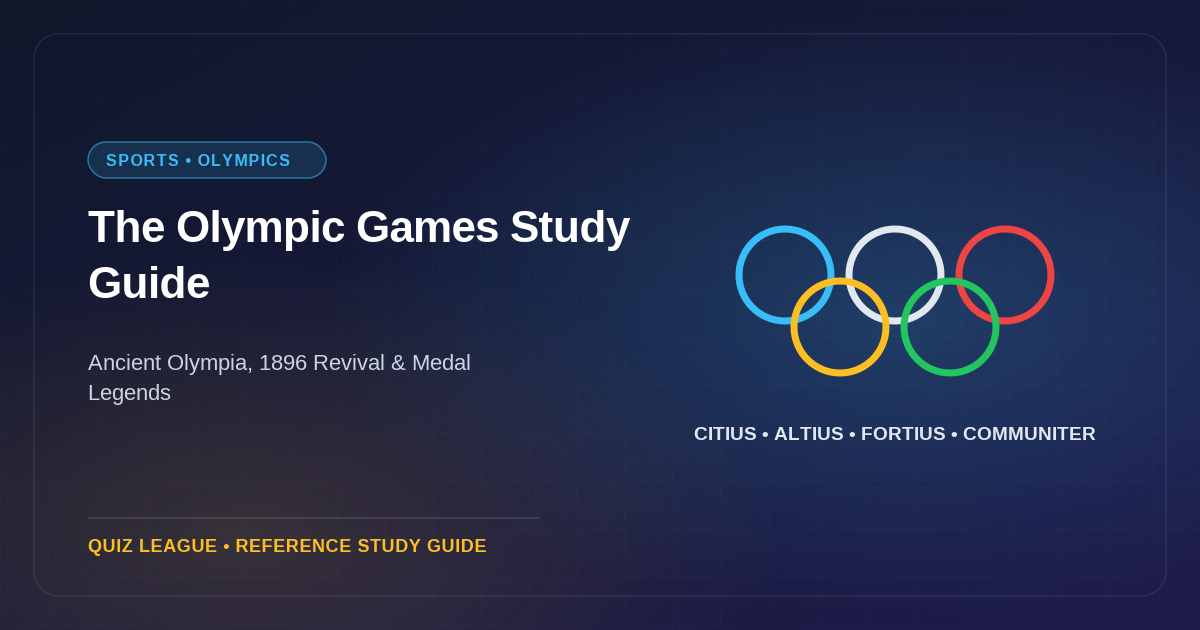
Coubertin designed the iconic five interlocking Olympic rings in 1913 (blue, yellow, black, green, and red on a white field), representing the union of the five inhabited continents and ensuring at least one color from every national flag at the time appeared. In 2021, the IOC updated its classic Latin motto—'Citius, Altius, Fortius' ('Faster, Higher, Stronger')—by adding 'Communiter' ('Together').
Key structural evolutions shaped the Games we watch today: women first competed in 1900 (Paris), with Charlotte Cooper winning tennis singles; the first Winter Olympics launched in Chamonix, France in 1924; the modern Torch Relay from Olympia was introduced in 1936; and since 1994, the Winter and Summer Games alternate every two years rather than falling in the same calendar year. Alongside the Olympics, Dr. Ludwig Guttmann's 1948 Stoke Mandeville Games evolved into the Paralympic Games, formally co-hosted since Seoul 1988.
- 1900 Paris: First Games featuring female athletes (22 women across tennis, golf, sailing, croquet, equestrian).
- 1924 Chamonix: Inaugural Winter Olympic Games.
- 1960 Rome: First Summer Olympics broadcast live internationally via television; Abebe Bikila wins marathon barefoot.
- 2024 Paris: First Summer Games to achieve full 50:50 gender parity across athlete quota places.
| Athlete | Country | Sport | Gold Medals | Total Olympic Medals | Signature Achievement |
|---|---|---|---|---|---|
| Michael Phelps | USA | Swimming | 23 | 28 | Most decorated Olympian of all time; 8 golds in 2008 |
| Larisa Latynina | Soviet Union | Artistic Gymnastics | 9 | 18 | Most decorated female Olympian (record held 1964–2012) |
| Paavo Nurmi | Finland | Distance Running | 9 | 12 | Most Olympic medals in track & field |
| Usain Bolt | Jamaica | Sprinting | 8 | 8 | Won 100 m & 200 m at three consecutive Games |
| Katie Ledecky | USA | Swimming | 9 | 14 | Tied Latynina for most golds by a female Olympian (Paris 2024) |
| Abhinav Bindra / Neeraj Chopra | India | Shooting / Javelin | 1 each | 1 / 2 | India's two individual Olympic gold medalists |
All-Time Olympic Legends and Unbreakable Marks
No Olympian matches American swimmer Michael Phelps, who captured 28 total medals—23 gold, 3 silver, and 2 bronze—across four Games (2004–2016), including a record 8 golds at Beijing 2008 alone. Soviet gymnast Larisa Latynina held the overall medal record for 48 years with 18 medals (9 gold), while Finnish runner Paavo Nurmi ('The Flying Finn') earned 9 athletics golds in the 1920s.
In track and field, Jesse Owens won four golds at Berlin 1936, Carl Lewis matched him in 1984 and won four consecutive long jump titles (1984–1996), and Jamaica's Usain Bolt swept the 100 m and 200 m at three straight Games (2008, 2012, 2016), setting still-standing world records of 9.58 s and 19.19 s in 2009. In gymnastics, Nadia Comăneci scored the Olympics' first official perfect 10.0 on uneven bars at Montreal 1976.
India's Olympic Journey: Hockey Dominance to Individual Golds
India first appeared at the 1900 Paris Games via Norman Pritchard (two athletics silvers) and sent its first official team in 1920. From 1928 to 1956, the Indian men's field hockey team—led initially by wizardry of Dhyan Chand—won six consecutive Olympic gold medals, adding two more in 1964 and 1980 for 8 golds total.
After decades awaiting individual Olympic champions, shooter Abhinav Bindra won India's first individual Olympic gold in the 10 m air rifle at Beijing 2008. At Tokyo 2020 (held 2021), Neeraj Chopra captured India's historic first athletics gold in men's javelin throw (87.58 m), later adding silver at Paris 2024 alongside double-medalist shooter Manu Bhaker. Earlier pioneers also forged unforgettable stories: wrestler K. D. Jadhav won independent India's first individual Olympic medal (bronze at Helsinki 1952), and Karnam Malleswari became the first Indian woman to win an Olympic medal (weightlifting bronze at Sydney 2000).
In the Olympic medal table overall, the United States leads all nations in cumulative Summer Olympic medals, while Norway leads Winter Olympic medal counts—and new sports like sport climbing, skateboarding, surfing, and breaking (Paris 2024) alongside cricket's upcoming return at Los Angeles 2028 reflect the Games' continual evolution.
Key Study Takeaways
- Ancient Games began around 776 BCE at Olympia; the modern Games debuted in Athens in April 1896.
- The five Olympic rings represent the five inhabited continents, designed by Pierre de Coubertin in 1913.
- Michael Phelps (23 golds, 28 total) and Larisa Latynina (18 total) top the all-time medal tables.
- India owns 8 Olympic men's hockey golds plus individual golds from Abhinav Bindra (2008) and Neeraj Chopra (2020).
Active Recall Practice Quiz
Test your retention of the material above. Attempt to recall each answer before clicking Reveal Answer, then grade yourself honestly.
Reference Sources & Further Reading
- International Olympic Committee (IOC) — Olympic Museum & Official Results
- International Paralympic Committee (IPC) — History of the Paralympic Movement
- Indian Olympic Association (IOA) — India at the Olympic Games