Origins of Cricket and the Birth of International Formats
Cricket grew out of rural bat-and-ball pastimes in southeastern England during the sixteenth century, with formal Laws codified by London's Marylebone Cricket Club (MCC)—still the custodian of the Laws of Cricket today, headquartered at Lord's Cricket Ground. The first official Test match took place in March 1877 at the Melbourne Cricket Ground (MCG), where Australia defeated England by 45 runs in a timeless contest that later inspired 'The Ashes' rivalry after England's 1882 defeat at The Oval.
Test cricket—played over five days in white clothing with a red leather ball (or pink ball in day-night Tests)—remains the sport's ultimate examination of temperament, pitch deterioration, and bowling endurance. For nearly a century, international cricket meant exclusively Tests until weather washouts in Melbourne in January 1971 prompted officials to stage an impromptu 40-over match between Australia and England, birthing One Day International (ODI) cricket.
In 2003, England's domestic Twenty20 Cup introduced a brisk three-hour format limited to 20 overs per side. Following India's dramatic triumph at the inaugural 2007 ICC World Twenty20 in South Africa and the launch of the Indian Premier League (IPL) in 2008, T20 cricket transformed global broadcasting, batting innovation, and franchise leagues.
Essential Pitch Dimensions, Laws, and Modes of Dismissal
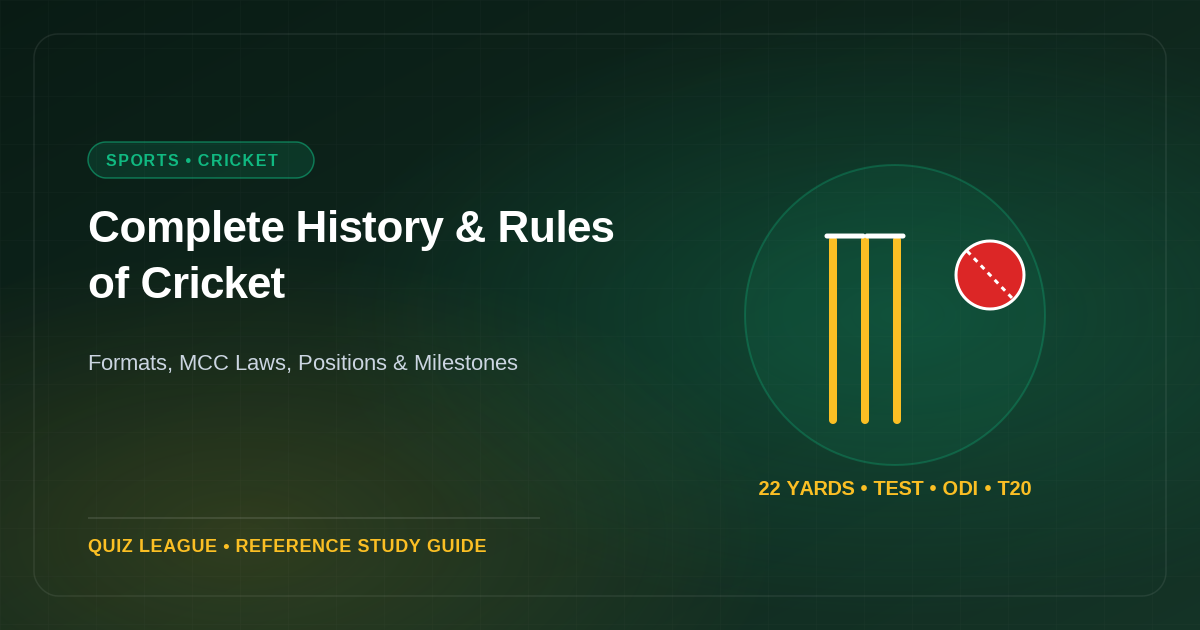
A regulation cricket pitch measures 22 yards (20.12 meters) in length between the two sets of three wooden stumps topped by two bails, set 28 inches (71.1 cm) tall and 9 inches (22.86 cm) wide. The popping crease lies 4 feet (1.22 m) in front of the bowling crease; a batter is safe from being run out or stumped only when their bat or body is grounded behind that line.
Under the MCC Laws of Cricket, there are ten recognized ways a batter can be dismissed, though six account for nearly every wicket in modern matches. Importantly, a 'no-ball' (such as overstepping the front crease) penalizes the bowling side one run, grants an extra delivery, and in white-ball cricket triggers a 'Free Hit' where the batter cannot be dismissed except via run out, hitting the ball twice, or obstructing the field.
- Primary Dismissals: Bowled, Caught, Leg Before Wicket (LBW), Run Out, Stumped, and Hit Wicket.
- Rare Dismissals: Timed Out (first witnessed in international cricket when Angelo Mathews was timed out against Bangladesh in the 2023 ODI World Cup), Obstructing the Field, Hit the Ball Twice, and Retired Out.
- Follow-On Rule (Test Cricket): A team leading by at least 200 runs after first innings in a five-day Test may compel the trailing side to bat again immediately.
| Format | Match Duration | Overs per Innings | Ball Color | First Men's International |
|---|---|---|---|---|
| Test Match | Up to 5 days | Unlimited (90 overs/day target) | Red (Pink for Day-Night) | March 1877 (AUS vs ENG, Melbourne) |
| One Day International (ODI) | ~7–8 hours | 50 overs per side | White (two new balls) | January 1971 (AUS vs ENG, Melbourne) |
| Twenty20 International (T20I) | ~3–3.5 hours | 20 overs per side | White | February 2005 (AUS vs NZ, Auckland) |
Understanding Fielding Positions and Bowling Variations
Cricket's colorful fielding map—silly mid-off, cow corner, gullies, deep backward square leg, and third man—makes complete sense once anchored to the batter's stance. For a right-handed batter, the side in front of their body as they take guard is the off side, while the side behind their legs is the leg side (or on side). 'Fine' means close to the line of the stumps behind the batter; 'square' means aligned roughly level with the popping crease; 'silly' denotes an ultra-close catching fielder under the helmet.
Bowlers divide broadly into pace (fast, seam, and swing) and spin (wrist spin vs. finger spin). Pace bowlers use shiny vs. rough sides of the cricket ball and seam angle to generate conventional swing early or reverse swing with an older ball, whereas spinners impart revolutions using fingers (off-break, left-arm orthodox) or wrist/flick action (leg-break, googly, doosra) to turn the ball off worn pitches.
Landmark Individual Milestones Across Formats
Statistical records showcase the sport's century-plus continuity. Australian legend Sir Donald Bradman retired in 1948 with a Test batting average of 99.94 across 52 Tests—requiring just four runs in his final innings at The Oval to reach 100 before falling for a duck to Eric Hollies. Among modern icons, Sachin Tendulkar remains international cricket's leading run-scorer (34,357 runs and 100 international centuries), while Sri Lankan off-spinner Muttiah Muralitharan holds the all-time international wicket record (800 Test wickets, 534 ODI wickets, 1,347 total).
In limited-overs cricket, Rohit Sharma holds the highest individual ODI score (264 against Sri Lanka in Kolkata, 2014) and Virat Kohli leads all-time ODI century charts after surpassing Tendulkar's 49 ODI hundreds during the 2023 World Cup. Meanwhile, England's Jim Laker (19/90 at Old Trafford, 1956) and India's Anil Kumble (10/74 against Pakistan in Delhi, 1999) remain two of only three bowlers alongside New Zealand's Ajaz Patel (2021) to capture all ten wickets in a single Test innings.
Key Study Takeaways
- The Marylebone Cricket Club (MCC) at Lord's remains the official guardian of the Laws of Cricket.
- A standard cricket pitch is 22 yards (20.12 meters) long between stumps.
- Test cricket uses red/pink balls across up to five days; ODIs and T20Is use white balls with fielding restrictions.
- Don Bradman's 99.94 Test average and Tendulkar's 100 international centuries stand among the sport's benchmark records.
Active Recall Practice Quiz
Test your retention of the material above. Attempt to recall each answer before clicking Reveal Answer, then grade yourself honestly.
Reference Sources & Further Reading
- Marylebone Cricket Club (MCC) — Laws of Cricket (2017 Code, 3rd Edition)
- ESPNcricinfo Statsguru — Official International Cricket Records
- International Cricket Council (ICC) — Playing Conditions