Byzantium and the Preservation of Roman Law
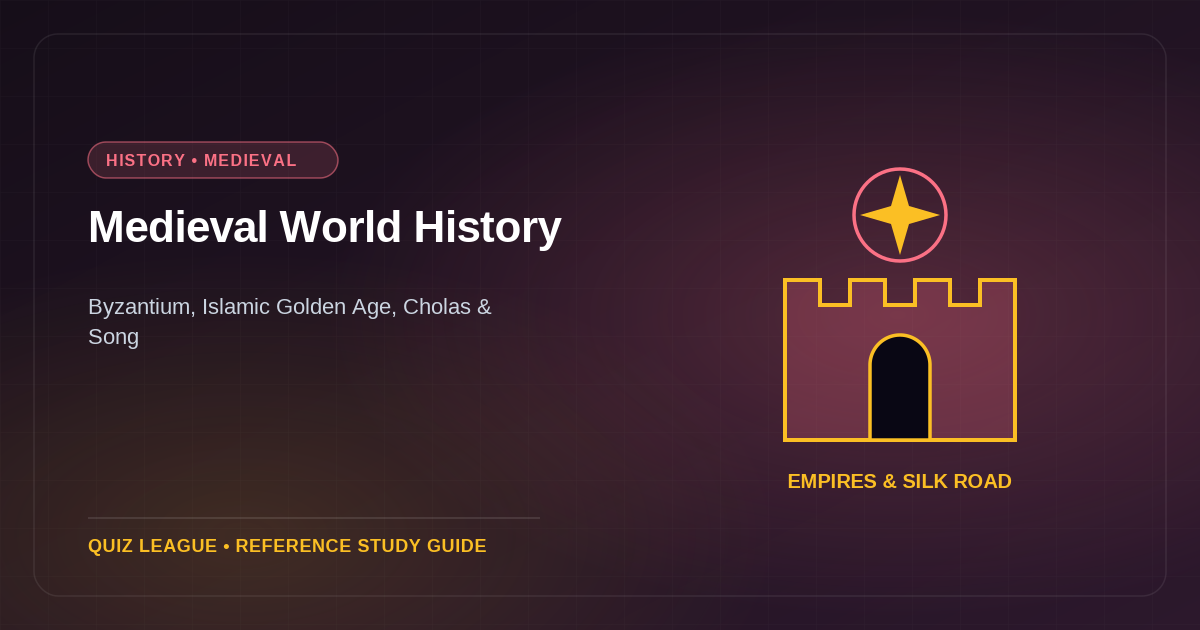
When the Western Roman Empire fractured in 476 CE, the Eastern Roman—or Byzantine—Empire endured for nearly another millennium from its fortified capital, Constantinople. Strategically straddling the Bosphorus Strait between Europe and Asia, Constantinople controlled lucrative trade between the Black Sea and the Mediterranean.
Under Emperor Justinian I (r. 527–565 CE), Byzantine jurists compiled the Corpus Juris Civilis (Justinian's Code), systematizing centuries of Roman legal thought into a foundation that still underpins civil law across continental Europe and Latin America. Justinian also commissioned the Hagia Sophia, whose massive pendentive dome redefined monumental architecture. Despite territorial losses to Arab armies in the seventh century and Seljuk Turks after the Battle of Manzikert (1071), Byzantium preserved Greek literature and Orthodox Christianity until Constantinople fell to Ottoman Sultan Mehmed II in 1453.
The Islamic Golden Age and Global Knowledge Networks
From the eighth to the thirteenth centuries, centers of learning across Baghdad, Cairo, Córdoba, and Samarkand drove extraordinary advances in mathematics, optics, medicine, and astronomy. Under the Abbasid Caliphate, Baghdad's House of Wisdom (Bayt al-Hikma) sponsored scholars who translated Greek, Sanskrit, and Persian treatises into Arabic and built upon them.
Persian polymath Muhammad ibn Musa al-Khwarizmi authored foundational works on solving linear and quadratic equations—giving us the word 'algebra' (from al-jabr) and 'algorithm' (from the Latinized form of his name)—while helping transmit the Hindu-Arabic decimal numeral system (including zero) westward. Ibn al-Haytham (Alhazen) pioneered experimental optics in his Book of Optics (Kitab al-Manazir), demonstrating that vision occurs when light enters the eye rather than beams leaving it. Meanwhile, Ibn Sina (Avicenna) wrote The Canon of Medicine, a standard medical text in Europe and the Islamic world for centuries.
- Paper Transmission: Papermaking spread from China through Samarkand (after 751 CE) to Baghdad, Cairo, and medieval Spain, accelerating book production.
- Maritime Compasses & Lateen Sails: Facilitated monsoon navigation across the Indian Ocean between East Africa, Arabia, India, and Southeast Asia.
- Magna Carta (1215): English barons forced King John to sign a charter establishing that even the monarch is subject to the law of the land.
| Empire / Dynasty | Core Region | Key Ruler / Scholar | Approximate Period | Notable Contribution |
|---|---|---|---|---|
| Byzantine Empire | Eastern Mediterranean | Emperor Justinian I | 330–1453 CE | Corpus Juris Civilis, Hagia Sophia |
| Abbasid Caliphate | Middle East & Persia | Al-Khwarizmi, Al-Ma'mun | 750–1258 CE | Algebra, House of Wisdom, optics & medicine |
| Imperial Cholas | South India & Bay of Bengal | Rajaraja I, Rajendra I | 850–1279 CE | Thanjavur temple, maritime expeditions, bronze art |
| Song Dynasty | China | Bi Sheng, Su Song | 960–1279 CE | Paper currency, magnetic compass, movable type |
| Vijayanagara Empire | Deccan & South India | Krishnadevaraya | 1336–1646 CE | Hampi architecture, spice & horse trade hub |
Medieval India: Chola Thalassocracy, Delhi Sultanate, and Vijayanagara
Medieval India witnessed remarkable political, architectural, and maritime dynamism. In the south, the Imperial Cholas under Rajaraja Chola I (r. 985–1014 CE) and his son Rajendra Chola I (r. 1014–1044 CE) built bronze casting masterpieces, monumental Dravidian temples like the Brihadisvara Temple at Thanjavur, and a powerful navy that projected trade and military expeditions across Sri Lanka and the Srivijaya Empire in maritime Southeast Asia.
In northern India, after the Battle of Tarain (1192), the Delhi Sultanate took root in 1206 under Qutb ud-Din Aibak, spanning five dynasties (Mamluk, Khalji, Tughlaq, Sayyid, and Lodi) over more than three centuries. Alauddin Khalji's market price controls and military defense repelled repeated Chagatai Mongol invasions that devastated much of Eurasia. Further south in 1336, Harihara I and Bukka Raya I founded the Vijayanagara Empire along the Tungabhadra River, turning Hampi into one of the wealthiest trading cities in the sixteenth-century world before its defeat at the Battle of Talikota (1565).
Simultaneously, medieval India experienced the transformative Bhakti and Sufi movements—led by poet-saints such as Kabir, Mirabai, Guru Nanak, Basavanna, Tukaram, and Chishti Sufi masters like Nizamuddin Auliya—who composed devotional verse in vernacular regional languages rather than exclusive Sanskrit or Persian, championing spiritual equality and weakening rigid social hierarchies.
Feudal Europe, the Crusades, and the Rise of Universities
In Western Europe between the ninth and thirteenth centuries, decentralized feudalism organized agrarian life around manorial estates, vassal oaths, and armored cavalry. Yet by the High Middle Ages, agricultural advances—the heavy wheeled iron plow, horse collar, and three-field crop rotation—boosted harvests and revived urban merchant guilds in northern Italy and Flanders.
Higher learning institutionalized with the founding of Europe's earliest degree-granting universities at Bologna (1088), Oxford (c. 1096), and Paris (c. 1150), drawing heavily on Latin translations of Arabic scientific and Aristotelian commentaries recovered through Toledo in Spain and Norman Sicily.
Song China, the Mongol Pax, and the Black Death
During the Song Dynasty (960–1279 CE), China experienced a commercial and technological surge: state-issued paper banknotes (jiaozi), coal-fired iron smelting, magnetic mariner's compasses, gunpowder weapons, and Bi Sheng's movable clay type (c. 1040 CE, four centuries before Gutenberg's metal press in Europe).
In the thirteenth century, Genghis Khan and his successors forged the largest contiguous land empire in history. Though Mongol conquests were devastating, the resulting Pax Mongolica briefly secured overland Silk Road caravans from China to the Black Sea, chronicled by travelers like Marco Polo and Moroccan jurist Ibn Battuta (who journeyed roughly 117,000 km across Africa, India, and China). Tragically, those same trade corridors carried Yersinia pestis—the Black Death—across Eurasia in the 1340s, killing an estimated 30% to 50% of Europe's population and accelerating the decline of serfdom and the transition toward the Renaissance.
Key Study Takeaways
- Justinian's Corpus Juris Civilis preserved Roman legal structures that later shaped European civil law.
- Abbasid scholars like al-Khwarizmi and Ibn al-Haytham transformed algebra, decimal arithmetic, and experimental science.
- The Chola and Vijayanagara empires anchored Indian Ocean commerce and temple architecture in southern India.
- Song China pioneered paper currency, gunpowder, and movable type centuries before early modern Europe.
Active Recall Practice Quiz
Test your retention of the material above. Attempt to recall each answer before clicking Reveal Answer, then grade yourself honestly.
Reference Sources & Further Reading
- Hourani, A. — A History of the Arab Peoples
- Sastri, K. A. Nilakanta — The Cholas
- Wickham, C. — Medieval Europe