Why River Valleys Anchored the First Urban Civilizations
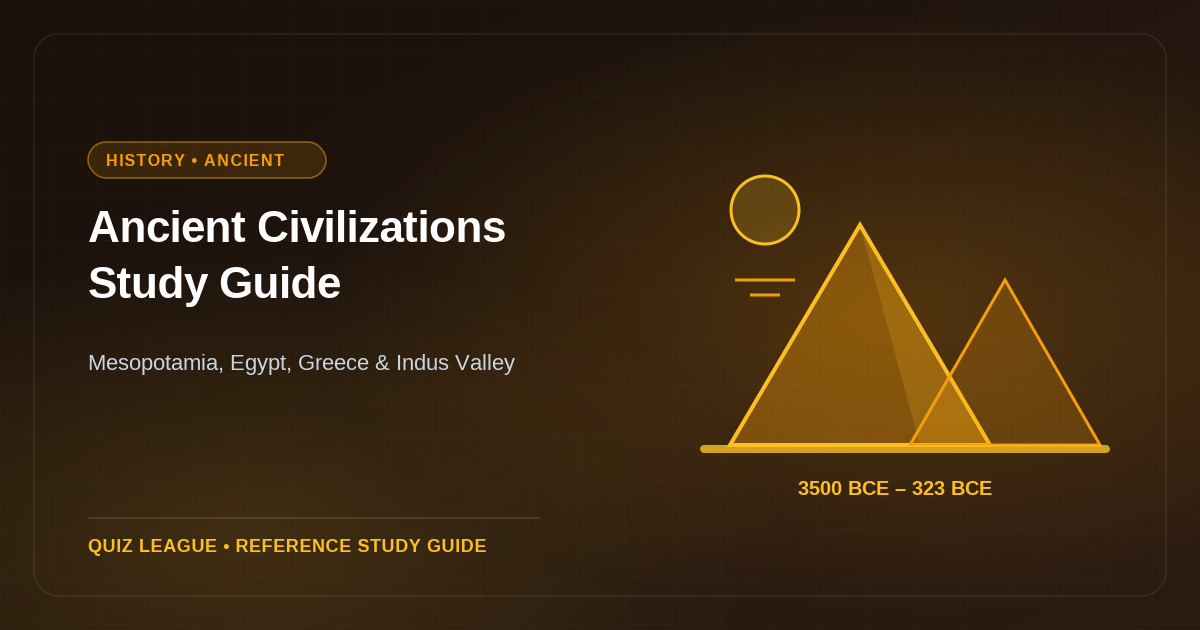
Around 3500–3000 BCE, independent urban societies emerged along major fertile river systems where seasonal silt deposition and irrigation agriculture generated reliable food surpluses. Surpluses freed portions of the population from daily farming, enabling specialized artisans, metallurgists, scribes, administrators, and long-distance merchants to gather in walled cities.
In Mesopotamia ('land between the rivers,' the Tigris and Euphrates in modern-day Iraq and Syria), Sumerian city-states such as Ur, Uruk, and Lagash pioneered monumental mud-brick ziggurats, the potter's wheel, bronze metallurgy, and sexagesimal (base-60) mathematics—the direct ancestor of our 60-minute hour and 360-degree circle. To track grain inventories and temple tributes, Sumerian scribes pressed wedge-shaped marks into damp clay tablets, creating cuneiform around 3200 BCE.
Centuries later, Babylonian king Hammurabi (r. c. 1792–1750 BCE) unified southern Mesopotamia and inscribed one of history's most famous legal collections onto a black diorite stele. Although Hammurabi's Code is remembered for strict 'eye-for-an-eye' proportionality among social equals, it also codified contract law, irrigation liability, and commercial accountability—establishing the principle that written law binds rulers and subjects alike.
Old, Middle, and New Kingdom Egypt Along the Nile
Unlike the unpredictable, violent floods of the Tigris and Euphrates, the Nile River inundated Egypt's narrow floodplain on a remarkably regular annual schedule each summer, fostering a stable, centralized monarchy under pharaohs viewed as divine mediators of cosmic order (ma'at). Upper and Lower Egypt were unified around 3100 BCE—traditionally attributed to Narmer (Menes)—launching the Early Dynastic Period.
During the Old Kingdom (c. 2686–2181 BCE), royal architects erected the Step Pyramid of Djoser at Saqqara (designed by Imhotep) and the Great Pyramids of Giza for Khufu, Khafre, and Menkaure. Egyptian scribes recorded royal decrees and funerary literature such as the Book of the Dead in hieroglyphs and cursive hieratic script on papyrus reeds.
After periods of decentralization, the New Kingdom (c. 1550–1070 BCE) projected imperial power into Nubia and the Levant under rulers like Hatshepsut (one of Egypt's most accomplished female pharaohs), Thutmose III, Akhenaten, Tutankhamun, and Ramesses II—who signed the Treaty of Kadesh with the Hittites around 1259 BCE, the earliest surviving international peace treaty whose texts exist from both sides.
- Rosetta Stone (196 BCE): Inscribed in hieroglyphs, Demotic, and Ancient Greek, enabling Jean-François Champollion to decipher Egyptian hieroglyphs in 1822.
- Indus Script: Remains undeciphered; found mainly on square steatite seals depicting unicorns, bulls, and geometric motifs.
- Linear B: Deciphered by Michael Ventris in 1952 as an early form of Mycenaean Greek.
| Civilization | Primary River / Region | Peak Era (Approx.) | Writing System | Signature Achievement |
|---|---|---|---|---|
| Mesopotamia (Sumer/Babylon) | Tigris & Euphrates | 3500–539 BCE | Cuneiform on clay | Base-60 math, ziggurats, Hammurabi's Code |
| Ancient Egypt | Nile River Valley | 3100–30 BCE | Hieroglyphs & Demotic | Pyramids of Giza, solar calendar, papyrus |
| Indus Valley (Harappan) | Indus & Ghaggar-Hakra | 2600–1900 BCE | Indus Script (undeciphered) | Grid cities, covered drainage, standardized weights |
| Classical Greece | Aegean & Mediterranean | 500–323 BCE | Greek Alphabet | Athenian democracy, tragedy, Western philosophy |
The Indus Valley (Harappan) Civilization: Urban Engineering at Scale
Flourishing across roughly 1.25 million square kilometers of modern Pakistan and northwestern India between c. 2600 and 1900 BCE (Mature Harappan phase), the Indus Valley Civilization exceeded both Mesopotamia and Egypt in geographic reach. Major cities including Harappa, Mohenjo-daro, Dholavira, Rakhigarhi, and Lothal were built along orthogonal grid streets using standardized baked bricks in a consistent 1:2:4 height-width-length ratio.
What makes Harappan cities extraordinary is their civic sanitation and lack of ostentatious royal palaces or giant tombs. Nearly every residence in Mohenjo-daro connected via terracotta pipes to covered brick street drains with inspection manholes. Mohenjo-daro's Great Bath represents one of antiquity's earliest public water-tight reservoirs, while Lothal in Gujarat featured a brick-lined tidal dockyard connecting trade vessels to Mesopotamian ports (referred to as 'Meluhha' in Akkadian cuneiform texts).
Harappan artisans standardized binary and decimal stone weights for commerce, crafted carnelian beads, and grew cotton among the world's earliest cultivators. Around 1900 BCE, shifting monsoon patterns, river course changes (such as the Ghaggar-Hakra system), and disrupted trade led to gradual de-urbanization into localized Late Harappan cultures.
Classical Greece: Polis Politics, Historiography, and Philosophy
On the mountainous Aegean peninsula, fragmented terrain fostered independent city-states (poleis) such as Athens, Sparta, Corinth, and Thebes rather than a single river-valley empire. Following the Persian Wars (490–479 BCE)—highlighted by the Greek victories at Marathon, Salamis, and Plataea—Athens entered its Classical Golden Age under Pericles, building the Parthenon atop the Acropolis and experimenting with direct citizen democracy (restricted to free adult male citizens).
Classical Greece also transformed intellectual inquiry. Herodotus earned the title 'Father of History' by investigating the causes of the Greco-Persian Wars, while Thucydides pioneered critical, evidence-based political history in his account of the Peloponnesian War between Athens and Sparta (431–404 BCE). In philosophy, Socrates' questioning method laid foundations for Plato's Academy and Aristotle's Lyceum, shaping logic, biology, ethics, and political theory for millennia. Later, Alexander the Great's conquests (336–323 BCE) fused Greek and Near Eastern cultures across the Hellenistic world from Egypt to northwestern India.
Key Study Takeaways
- Sumerian cuneiform (c. 3200 BCE) and base-60 arithmetic left lasting legacies in timekeeping and geometry.
- Harappan cities like Mohenjo-daro and Dholavira prioritized municipal drainage, grid streets, and standardized brick ratios over royal monuments.
- The Rosetta Stone provided the trilingual key that allowed Jean-François Champollion to decode Egyptian hieroglyphs in 1822.
- Thucydides introduced secular, cause-and-effect historical analysis during the Peloponnesian War.
Active Recall Practice Quiz
Test your retention of the material above. Attempt to recall each answer before clicking Reveal Answer, then grade yourself honestly.
Reference Sources & Further Reading
- Van De Mieroop, M. — A History of the Ancient Near East
- Possehl, G. L. — The Indus Civilization: A Contemporary Perspective
- UNESCO World Heritage Archives — Memphis/Giza, Mohenjo-daro, Dholavira, and Acropolis